03 · Ordre de marche
Where to start with AI? Three weeks to decide, with your numbers in hand.
The people I meet, owners of small and mid-sized companies, subsidiary heads, business unit leaders in larger groups, are in one of two situations. Either a long list of things to automate, with no criterion to sort it. Or nothing specific: the feeling they should be moving on AI, and no idea where to start. In both cases the answer is the same: look at how your business makes and loses money, where it rests on a single person, and what your strategy needs first. That's what I do with you over three weeks. You leave with three workstreams, each carried by someone on your team.
You arrive with
A question: where to start with AI? Sometimes a list of tasks to automate, sometimes nothing specific yet.
I look with you at
Your strategy, ten numbers, the people who carry the business, what annoys your teams, and the map of your processes.
You leave with
Three workstreams in order, an owner on your team for each, and a first visible win within the month.
The thread with my method: the model before the tool. AI priorities are read in your strategy and your profitability, not in a catalogue of tools. One practical note: the engagement runs in French, and so do the documents shown below.
How it works
Three 45-minute meetings. Most of the work happens in between, and I'm the one doing it.
- Day 0
Framing
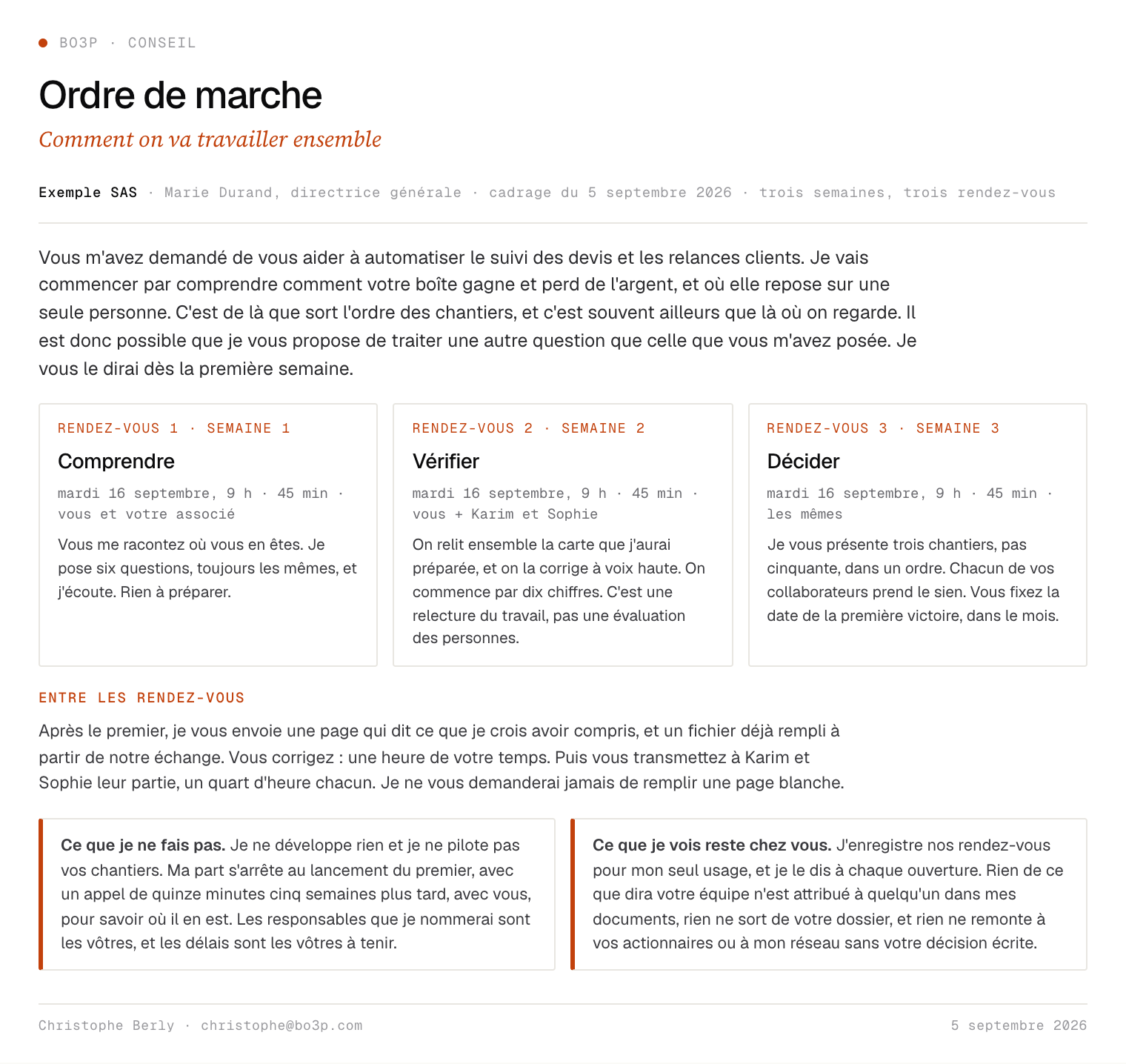
Thirty minutes on the phone. We check it's worth it, we set the three dates. Within the hour, you receive a one-page note on how we'll work.
The opening note - Week 1
Meeting 1 · Understand
45 minutes, you, alone or with a partner. You talk, I ask six questions, always the same ones, and I listen. Nothing to prepare.
- Same evening
What I understood
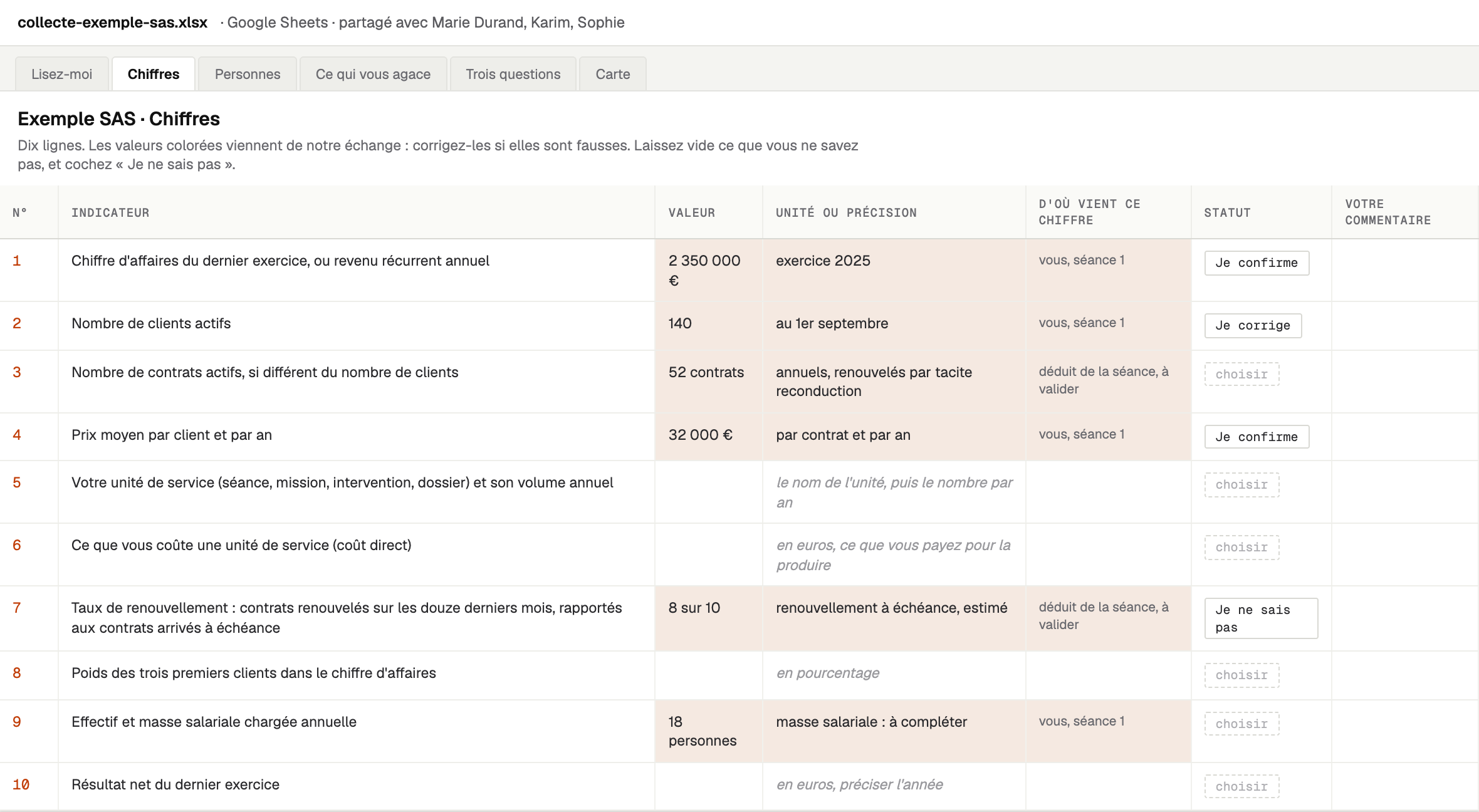
I send you one page, and a file already filled in with what you told me. You correct it, one hour. Your team members complete their part, fifteen minutes each.
The pre-filled file - Week 2
Meeting 2 · Verify
45 minutes with two or three of your people, you in the room. Ten numbers read aloud, then the map of your processes reviewed and corrected together.
- Week 3
Meeting 3 · Decide
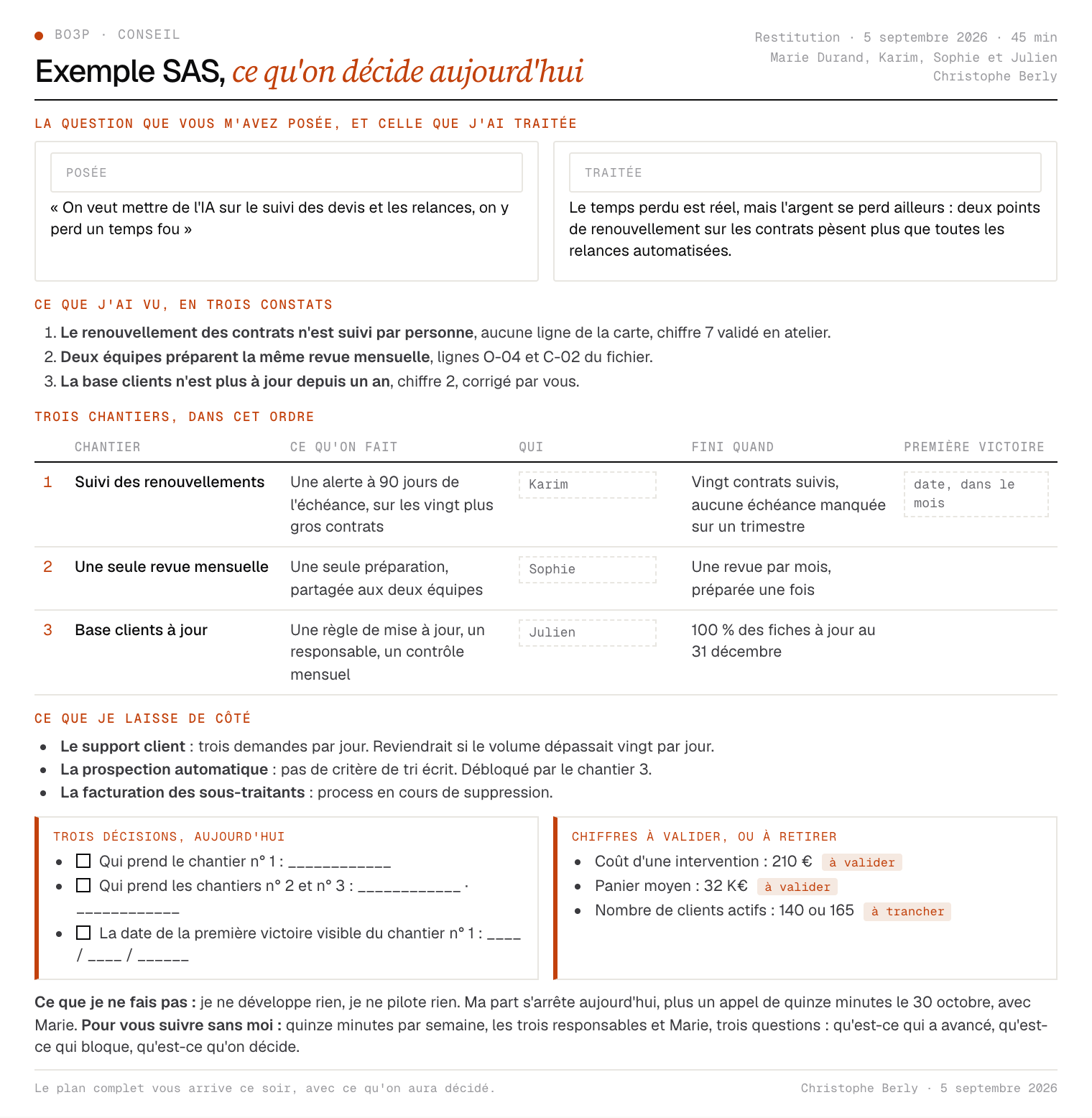
45 minutes, same people. I present three workstreams, in order. Each of your people takes theirs, and you set the date of the first win.
The summary, then the plan - Five weeks later
A phone call
Fifteen minutes, you and me, to know whether the first win landed and what got in the way. After that, I'm out of the loop.
What you receive
Short documents, written to be corrected.
The opening note
Sent within the hour after framing: the three dates, what I ask of you between meetings, what I don't do, what I see and what stays with you.
Example, fictitious data, in FrenchThe pre-filled file
Six tabs: ten numbers, your people, what annoys, three questions, the map of your processes. What sits on a coloured background comes from our conversation. You strike out, you correct, line by line.
Example, fictitious data, in FrenchThe summary, then the plan
One page I present aloud at the third meeting. The full plan comes the same day: for each workstream, why this one, who carries it on your team, done when, and what I leave aside.
Example, fictitious data, in FrenchThe time it takes you
What I mostly ask is that you hold the three dates.
On my side, most of it happens between meetings: reading what you send, extracting, filling the file, drawing the maps, sorting, writing the plan. That's where the quality of what you receive is decided, and that's why I do it myself.
How I sort
By euros moved, not hours saved.
A ninety-minute task done once a quarter never gets automated. A ten-minute task done two hundred times a month does. And in a team of ten or twenty people, hours saved are the smallest deposit there is: a contract that leaves, or one you don't sign, weighs far more. So I rank in this order.
The bar shows the order of magnitude of what it moves in euros, for a services business of ten to fifty people.
"Automate" means three different things
Remove the task
The most expensiveThe machine does everything, nobody checks. The most expensive to build, and the only regime that can put a visible mistake in front of a customer.
A draft a human validates
Almost always the right answerThe machine prepares, someone rereads for thirty seconds and sends. Ten times cheaper, reversible.
Trigger at the right moment
The most overlookedAn alert, a reminder, a follow-up. The cheapest of the three. No AI needed.
Most workstreams end up in the last two: simple pipes between your tools, and a written rule. AI is only useful where there is no clear rule, to sort a request, summarise, draft.
What I look for
Twelve things you stop seeing when you're inside.
They come back from one business to the next, in four families. I look for all of them, in your numbers, in the map, and in what your teams say at the workshop. I keep none without a line of the file or a sentence from a meeting to back it.
Money
- The wrong metric
- Ranking by hours saved when the money is lost elsewhere.
- Not enough volume
- The most visible task on the list, too rare to be worth it.
- Concentration
- A customer so large that losing them wipes out the margin.
People
- Dormant capacity
- Someone on the team no step of the map mentions.
- The human constraint
- A plan that doesn't fit the workload of the people meant to carry it.
- Risk without an owner
- Something running with no one responsible, and no one to fix it when it breaks.
The map
- The duplicate
- The same work done twice, by two teams, with the same tools.
- The master link
- The bottleneck all the others depend on.
- The hole in the map
- A function the map doesn't show, because you carry it yourself.
- The condemned process
- A process you want to automate when it's already decided to drop it.
Assets and rules
- The dormant asset
- Something already built and paid for, no longer used.
- The missing criterion
- A decision impossible to automate because the rule was never written down.
My role, and yours
What I do, and what I don't
I build nothing and I don't run your workstreams. I stop at the launch of the first one, plus a phone call five weeks later. The owners I name are on your team, and so are the deadlines. I record our meetings for my own use, I say so every time, and nothing your team says leaves your file, neither towards your management or shareholders, nor towards my network.
What I ask of you
Three things, which I check on the first call. Hold three meetings in three weeks. Accept that I may address a different question from the one you ask, if your numbers lead me there. And have someone on your team to build what we decide. If one of the three is missing, I say so, and we don't go ahead.
Questions I get asked
We start with thirty minutes on the phone. Nothing to prepare: bring what annoys you.
This page also exists as a PDF (in French), to pass around internally.