AI is a question to think through, before it is a tool to deploy.
Most executives who bring AI into their company pick a tool before asking the right question. The outcome: productivity on secondary tasks, while the business model stays intact.
Christophe Berly, entrepreneur: three companies in twenty years, one listed on Euronext, then three years deploying AI at scale at GetVocal.
The same list of six tasks, ranked two ways
- 61Alert before a contract renewal3 h / month€120k / year
- 32Reply to quote requests22 h / month€76k / year
- 43Chase overdue invoices14 h / month€52k / year
- 14Meeting minutes40 h / month€19k / year
- 25Sorting incoming mail30 h / month€14k / year
- 56Formatting reports9 h / month€6k / year
Ranked by euros moved, the list starts with the renewal alert. Hours saved come after.
Ranked by hours saved, the list starts with the meeting minutes. The renewal alert, which protects the most money, comes last.
Fictitious example, a services company of about twenty people.
AI deployed at GetVocal for


Where we start
Ordre de marche: three weeks to know where to start with AI.
Whether you have a long list of things to automate or no idea where to begin, the question is the same: what matters for your strategy and your profitability? Over three weeks, I look with you at how your business makes and loses money, and where it rests on a single person. You leave with three workstreams, each carried by someone on your team. I build nothing, I run nothing.
3 meetings of 45 minutes, over 3 weeks. 4 h of your time. 3 workstreams, not fifty.
- Day 0
Framing
Thirty minutes on the phone. We check it's worth it, we set the three dates.
- Week 1
Understand
You talk, I ask six questions, always the same ones. Nothing to prepare.
- Week 2
Verify
Ten numbers read aloud, then the map of your processes corrected together.
- Week 3
Decide
I present three workstreams, in order. Each of your people takes theirs.
- Five weeks later
A phone call
Fifteen minutes to know whether the first win landed. After that, I'm out of the loop.
What you receive
Short documents, written to be corrected.
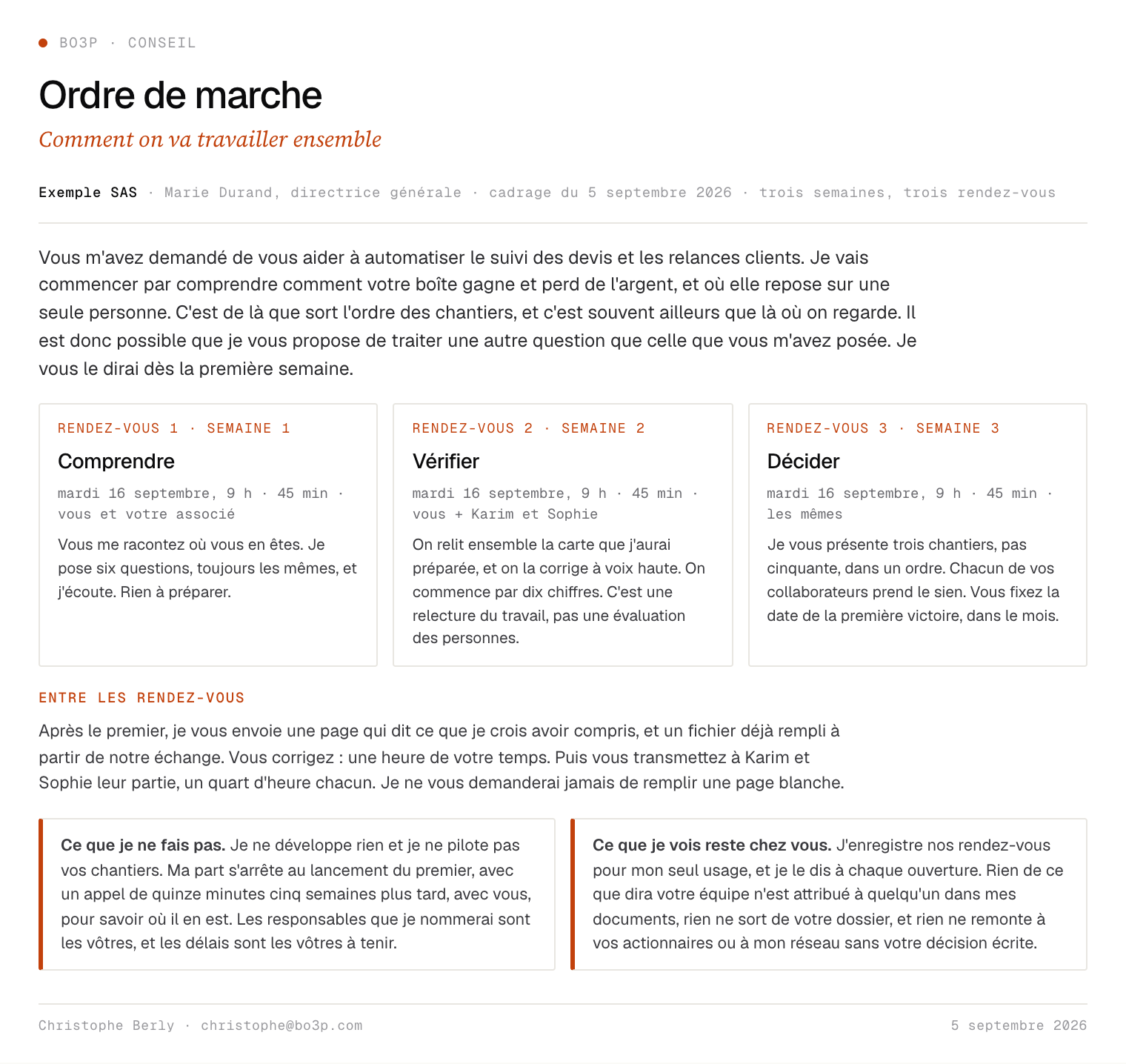
The opening note
Sent within the hour after framing: the three dates, what I ask of you between meetings, what I don't do.
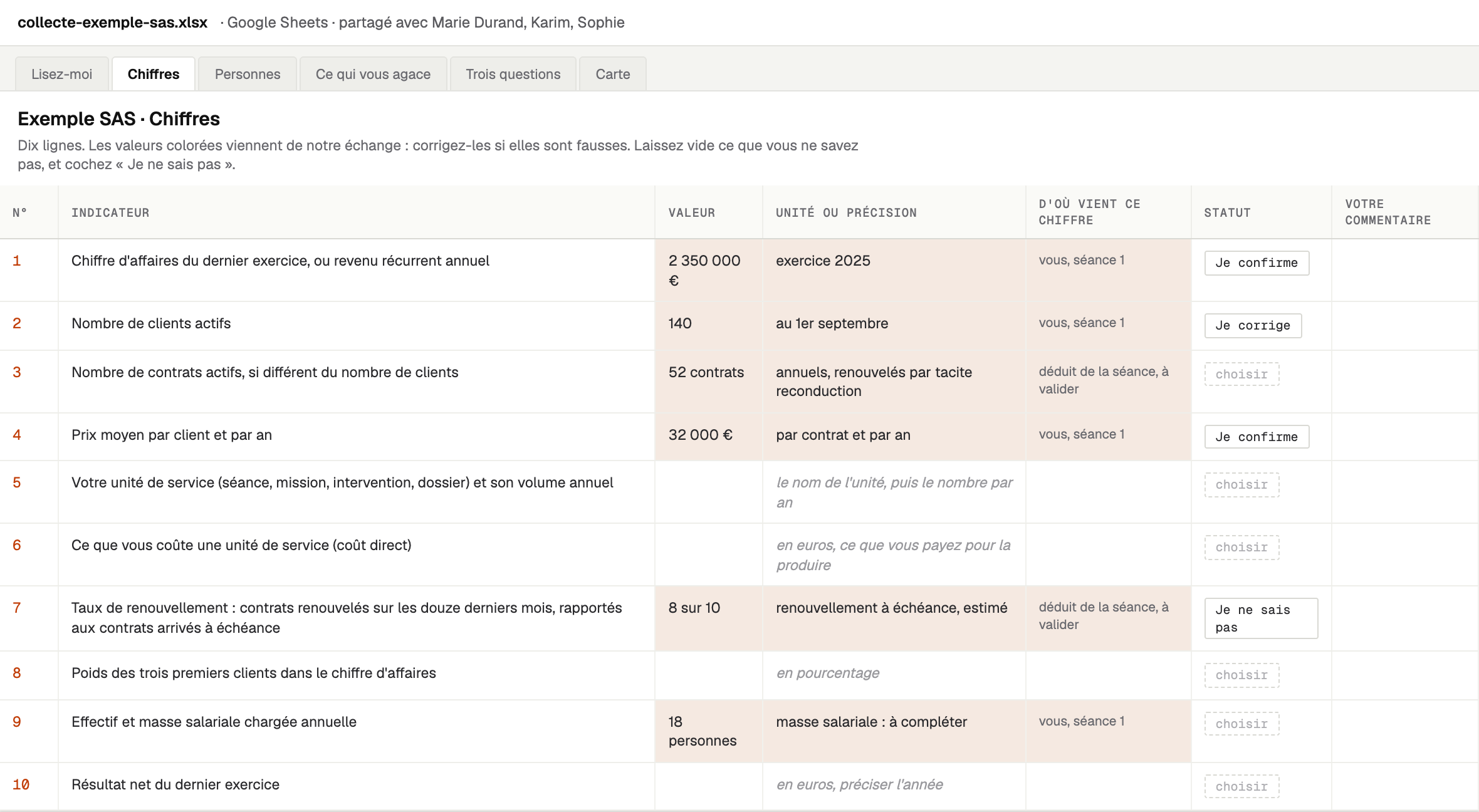
The pre-filled file
Six tabs: ten numbers, your people, what annoys, three questions, the map of your processes. You correct it line by line.
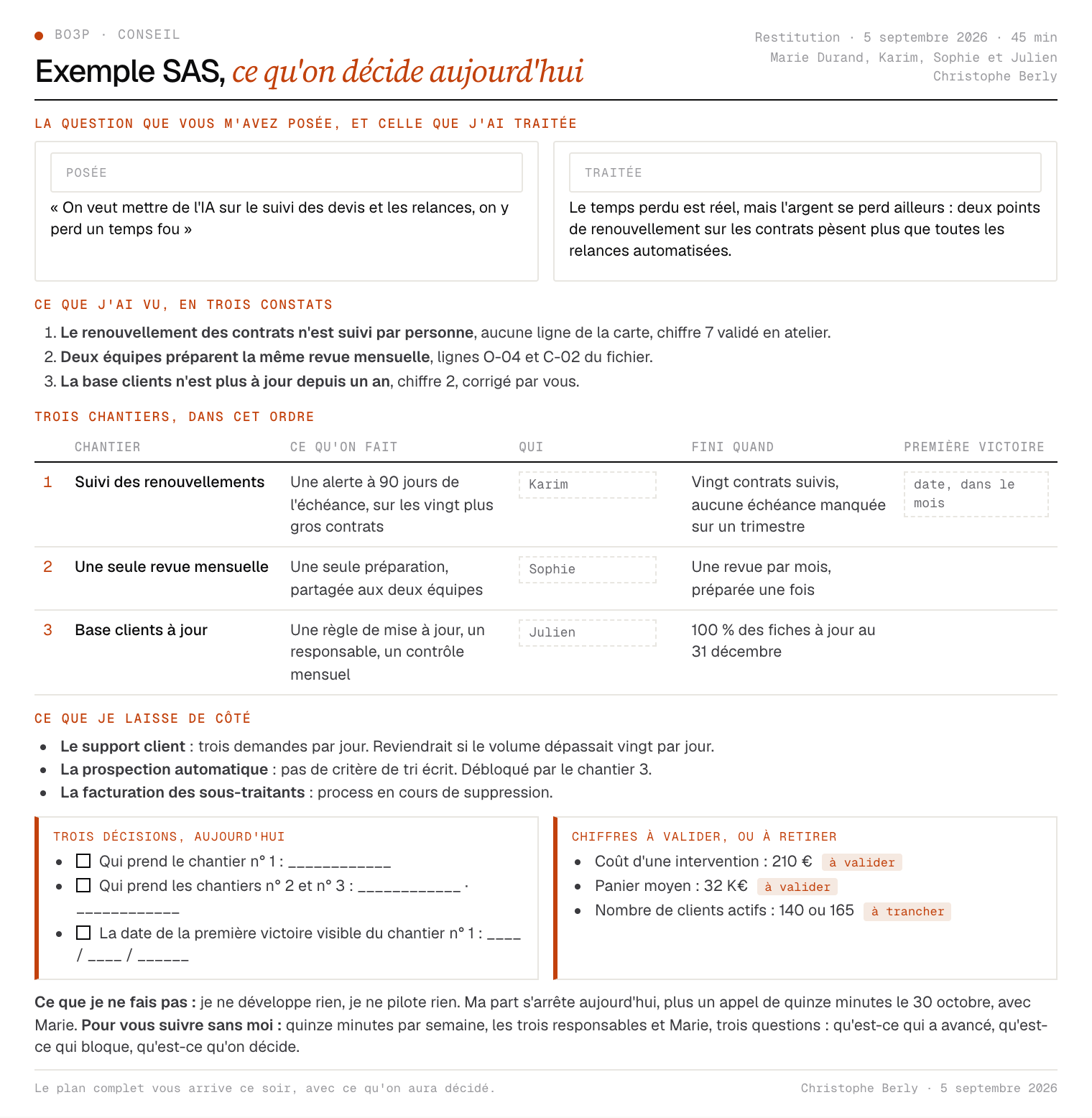
The summary, then the plan
One page I present aloud at the third meeting. The full plan comes the same day.
Examples with fictitious data (company "Exemple SAS"). The engagement and its documents are in French.
Advisory
Depending on your question, three other ways to engage.
Conversations
Think AI with you, before turning it into a project.
Strategic sessions on your business model, your levers, what AI actually changes for a company like yours.
Immersion
Show in real time what's possible.
A day with your executive committee to demystify, handle, understand. Neither demo nor training: a field exercise.
Deployment
Scope, prioritize, avoid wrong turns.
Support on the first initiatives. Autonomy as the goal, not the option.
Additional option, team AI awareness: short sessions to build the right reflexes and open the scope of what's possible.
See the advisory detailsThe question to ask
What does my business model become if I treat AI as an expansion of what's possible?
Who's speaking

Entrepreneur. Founder of Ordissimo (listed on Euronext) and Merci Julie. Founding partner of 50 Partners. Operating partner at GetVocal, where I led the AI deployment for Equans, Glovo, Movistar, Europcar, Austrian Post, Assursafe.
Twenty years of entrepreneurship on the business side. Three years of AI at scale on the operational side. It's this dual competence, rarely held by a single person, that I bring.
- 2002Ordissimo80 people, listed on Euronext in 2018
- 201150 PartnersOver 200 active participations
- 2017Merci Julie50 people
- 2023GetVocalFrom 0 to 70 people